Visual and Material Culture 341 / Book Studies 341: Archeology of Text:
Archival Research Methods and “the Book” in the Internet, Print, and Manuscript Eras
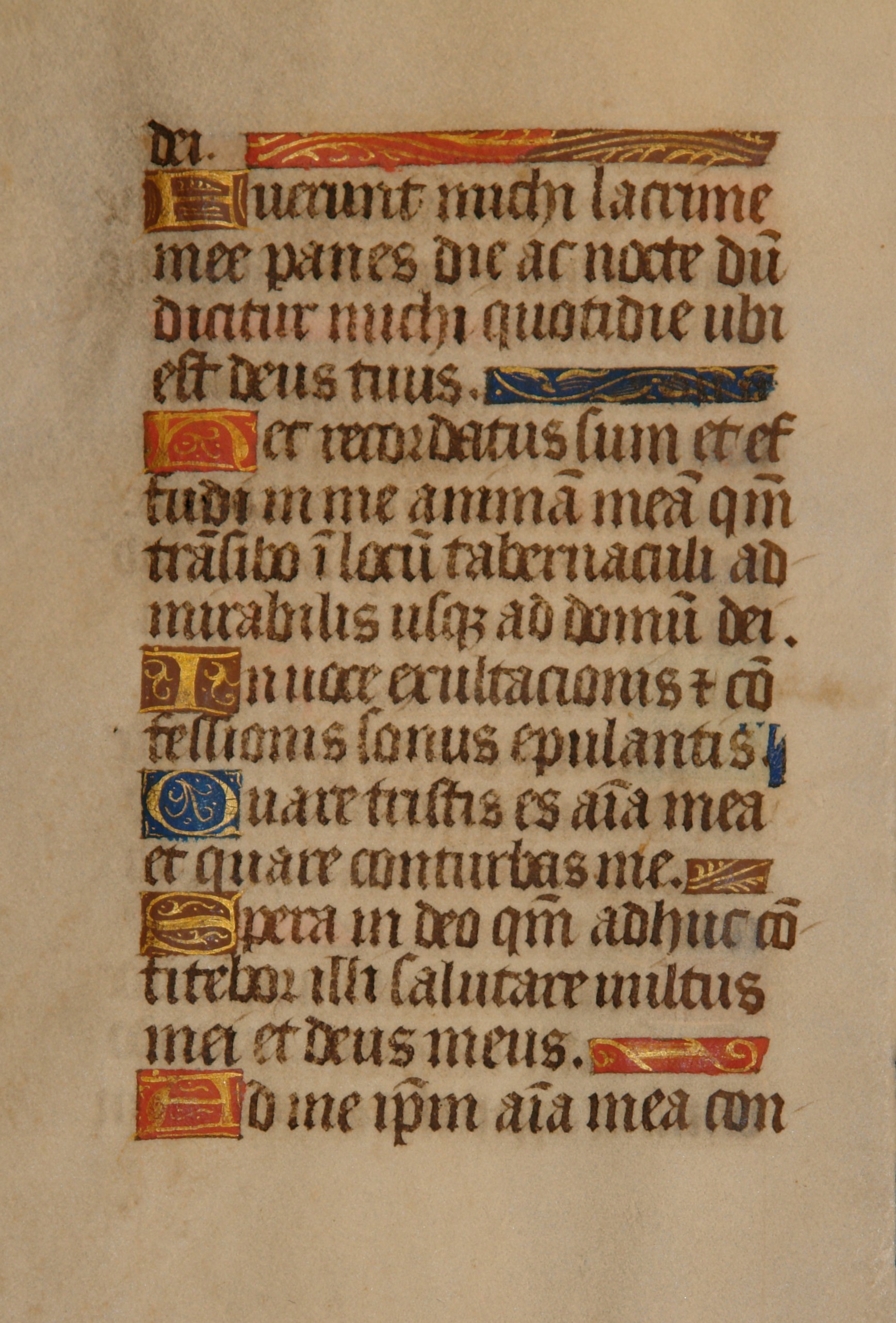
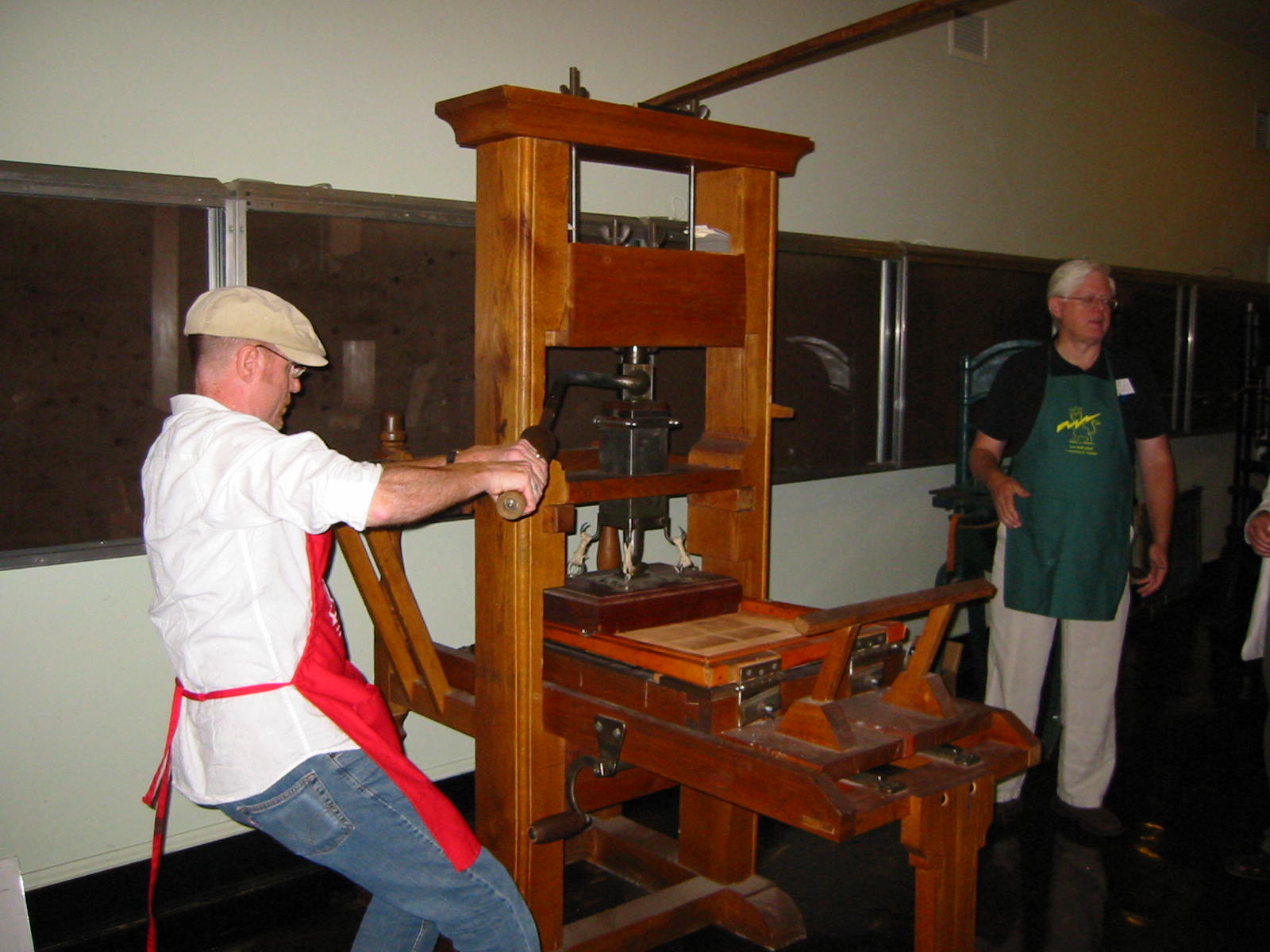
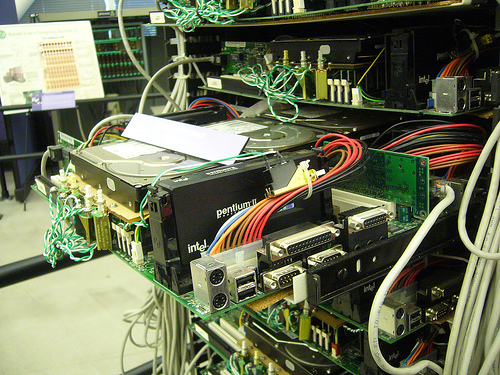
Manuscript leaf from a Book of Hours A printer working a wooden hand press 1st Google server (Takuya Oikawa, Flickr "Computer History Museum")
Fall 2023 (MW 10:40-12:30) Athenaeum Room 435 (Special Collections and Archives, 4th floor)
Instructor: Arnie Sanders, Emeritus Associate Professor of English, and Bibliographic Description Volunteer at Goucher Library Special Collections (Last edited: 12/12/2311:30 AM.)
Office Hours: because I finally seem to be really, really retired from in-person regularly scheduled teaching and the course is no longer being offered, there are no regular office hours. However, I would be happy to meet with people interested in studying the history of text making, text storage, and text use. This can include penwork (paleography--making and reading old manuscript hands or modern cursive, etc.); analysis and evaluation of old books whether to estimate their dollar value or their cultural significance (bibliography); analysis and evaluation of images for their content and origins in various traditions of image making (iconography). To make an appointment with me when I am usually volunteering as a bibliographer at Special Collections between 11:30 and 4 Tu/Th, email me at asanders[at]goucher.edu, or Deborah Harner (deborah.harner[at]goucher.edu) and copy Kristen Welzenbach (kristen.welzenbach[at]goucher.edu)--replacing [at] with the @ sign. [It's an ancient device to thwart robotic agents who scrape the Internet for useful active email addresses to use in impersonation scams, AKA phishing, etc.] Please give us at least 24 hours notice for best results.
I will leave the website up as a potentially useful resource but will not routinely update or correct pages unless you notify me about something rather important and urgent. Even websites get retired eventually.
My last teaching advice: learn that "A.I." is artificial but not
"intelligent." We imbue chatbots with imaginary intelligence
because we came into language, ourselves, believing that
language-emitting sources were intelligent, as we were, and we learned
by anticipating what the intelligent beings who taught us were trying
to "mean." A chatbot does not "try to mean." It produces
strings of text its algorithm calculates would probably be satisfactory
in response to the prompt it was given. It is glorified
spell-check and grammar-check. Nobody would seriously attribute
"intelligence" to those programs. As Emily Bender, Timnit Gebru,
and colleagues demonstrated in 2021 (in a scholarly article Google
tried to suppress), chatbot responses are best understood as
"stochastic parrots," automatically generating text strings that repeat
somewhat randomly what their database inputs already have
recorded. (For the original article, search for "On the Dangers
of Stochastic Parrots" and read the version archived by the ACM Digital
Library. Or see Bender's The AI Con [2025] in the Goucher Library print collection for a fast explanation of how the deception works.) When
you "use ChatGPT" or "use Claude" or other chatbots, you are training
them. That is, they are using YOU, free of charge (or you may
even be paying for the right to train them). Your interactions
automatically become the property of the 'bots' owners and are used to
generate future deceptive interactions with future human users.
Read Karen Hao's Empire of AI
(2025) in the Goucher Library print collection for the horrific
backstory of how OpenAI and other 'bot makers first used underpaid and
abused labor in Kenya, Venezuela, Columbia, and other collapsing
economies to Pretrain (the "P" in GPT) their algorithms to weed out
sadistic, sexually exploitative, racist, and other types of offensive
training content scraped from Youtube, Reddit, and other internet
stores of public text and images. The damage done to the workers
they hired, underpaid, and then fired led to the workers' long-term
psychological damage and loss of family relationships. Every time
someone uses a chatbot, the 'bot output is resting on the
near-slave-labor of those workers, and on the stolen labor of
contemporary "users" (i.e., YOU) which becomes yet another layer in the
programming.
The worst consequences of students' (and faculty members' and
administrators' [!]) seduction by these 'bots is that interaction with
the 'bots also trains the "users" to think more like the 'bots,
accepting likely-seeming simulations of thought for thinking, accepting
plausible but unsupportable claims as "facts," and trading accurate
truth for speedy near-term success at small tasks. Unfortunately,
those "small tasks" are intended to accomplish greater things, like
training human minds to think, designing course syllabi and lesson
plans to do so, and managing faculty and students to keep that
happening in the long run. All of it is undermined and will
eventually be seriously damaged by continued use of "A.I." (often now
concretized as "AI" as if the "A" and "I" did not abbreviate something
debatable--what the Marxists call "reification," making a "thing" out
of something that is not a thing but a concept/notion/fraudulent
proposition). Pay attention to what is happening. Resist
the machines. Don't become one.
Olds [i.e., what used to be News]: 12/12/23--To
enable me to compare the descriptive bibliographies to the books,
themselves, I will be at Special Collections tomorrow (Wednesday 12/13)
from about 10:30 to 4:00. Please email me if you need a
conference. Also, if you have set up a PowerPoint or other
audio-visual aid for your preliminary report on Friday, please send me
the link so that I can attach it to our schedule. Revised titles
will also be changed, too. Here's the current page: http://faculty.goucher.edu/eng241/VMC_341_IRP_Pre_Schedule_F23.html
Final
Experience for VMC 341 will take place 9:00 AM to 11:00 AM on Friday,
12/15. Written reports on your projects are due by midnight,
Sunday, 12/17. If travel or other problems cause delays, please
let me know as soon as possible so that we can negotiate. My
deadline for turning in grades is Tuesday 12/19, so there is not much
slack for any of us. Georgia's "December graduating senior" grade
is due on Monday. If you can turn in your written report
sooner than Sunday, it will be a great help.
If you want to see what kinds of
research the course will prepare you to conduct, use the following
link
to look at the PowerPoint and video presentations of last Spring's
students to give you a good sense of what the course can train you to
accomplish: student presentations of prelminary results for their independent research projects for Spring 2022.
Always remmeber to wash your hands before entering Special
Collections. It takes time to develop the habit, and it will be
important to our hands-on work with early printed books and
manuscripts. Think of it--bibliographers were hand-washing before
Covid-19!
--------------------------------------------------------------------------------------------------------------------------------
If you are on campus, by appointment you can visit Special Collections and Archives on the 4th floor of the Athenaeum between 10-12:30 and 1:30-4 Mondays through Thursdays. Contact Debbie Harner (Public Services and Education Archivist, deborah.harner@goucher.edu, 410-337-6075) or Kristen Welzenbach (Curator of Special Collections and Archives, kristen.welzenbach@goucher.edu,410-337-6370) to make an appointment for in-person research. Note that they are NOT available for impromptu conferences because they are in charge of supervising and maintaining the entire rare book collection. Click here for the official SC&A research policies and procedures: https://www.goucher.edu/library/special-collections-and-archives/research/ If digital browsing is more your thing, see our Book Arts Baltimore blog for examples of research and descriptive bibliography using books from Goucher's collection: https://blogs.goucher.edu/book-arts-baltimore/category/community-contributions/ (Scroll down past the first five for the ones based on our collection.)
Links to Previous Project, Classes, Events, and Useful Sites.Our motto: tolerate mystery as a precondition to discovery.
Summary
This interdisciplinary course introduces students to archival research techniques using Goucher’s Rare Book Collection and online digital archives, including cached web history like the Internet Archive. Working backward in time, from the present to the Medieval period, the course will survey the ways people have packaged and used written/visual information, from digital media to early printed pamphlets or books to manuscripts. Students who have completed the course will be equipped to do additional archival research in Goucher's archives for 200- and 300-level courses, and to work as “archival assistants” in the Special Collections division of the Goucher Library. This training also enables students to conduct research in authors' manuscript drafts of literary works, to pursue primary source research in Modern Languages, Hispanic Studies, History and Art History, and to apply their previous training in biology and chemistry to the forensic analysis of documents. Students with Literature 341 experience, and who have suitable proposals and letters of introduction from Goucher's librarians and a faculty member in the field, usually can get access to rare books and manuscripts in archives and special collections around the world. Students who successfully complete the course are strong candidates for Peirce Center Fellowships which pay stipends to support research in Special Collections during any semester, in January, or during the summer. Previous years' students have won competitive internships.
Student Learning Outcomes (vulgo dicta, "SLOs"):
1) Students will understand how digital text files are coded, stored, and how they may relate to manuscript or print versions of the text as a digital "edition." Students will understand how text files are retreived from the Internet, with special emphasis on text-base construction and maintenence, search engine use and awareness of the Internet's history as an ongoing element of the Archeology of Text. They will be aware of and able to compensate for (in most cases) the inevitable degradation and loss of digital texts due to causes such as "link rot," version incompatibility, hardware and software obsolescence, Darknet criminal activity, and ordinary commercial negligence or malfeasance. They will be able to describe and analyze Web site structures, text displays including images (still and full-motion), and other attributes of digital texts. Superior students will be able to create their own Web sites and digital editions of well-edited texts.
2) Students will be able to handle safely and describe accurately the structure of any modern or pre-modern printed book, including format, paper, typography, mise-en-page, and bindings. Superior students will be able to write near-perfect diplomatic transcriptions of early modern editions, with explanatory notes and appropriate bibliographic references. All students will be able to read, and to write, standard bibliographic descriptions following the Bowers-Gaskell rules. All students will be able to write rudimentary copy-specific notes that might be used in MARC entries for their own or the Library's rare book collection. Superior students will be able to write "desbib" for complex edition-copies, including those which do not fit the standard WorldCat or ESTC descriptions of their editions. All students will be able to use the Haebler "M" series table of incunabular founts, and to use standard typographic terms to describe type founts used to print any book. They will be able to detect, measure, and describe the dimensions, chain-lines, and watermarks in laid paper. Superior students will be able to use standard watermark collections to estimate the era and (sometimes) country of origin of a given book's paper stock. All students will be able to describe standard pre-modern bindings in terms of parchment or other binding materials, sewing patterns, backing bands, clasps, and other artifacts. They will be able to use tables of modern publishers' bindings to identify them on copies of post-1800 editions. They will be able to use the English Short Title Catalog (ESTC), WorldCat, and the Karlsruhe University online catalogues to assist in identification of the edition of a given copy of any pre-1800 book. They will have some experience of the use of ABEBooks.com, Alibris, and other online booksellers to estimate the rarity and relative worth of a given copy of a printed book. Superior students will become proficient comparative analysts of one or more authors' bibliographic output, and will be able to demonstrate the comparative worth of edition-copies of a given work based on copy-specific points of description known to scholars in standard bibliographic references for the work.
3) Students will be able to work safely with fragile paper and parchment manuscripts, and will understand the basic scholarly vocabulary used to describe MSS. They will be able to read, and to date by era, some representative Continental and English manuscript hands from the Carolignian through the Victorian periods. They will be able to create at least rudimentary alphabets in Carolignian uncial, Gothic, and Gothic Bastarda hands. Superior students will be able to create their own manuscripts using calligraphic hands appropriate to the texts and audiences for which the MSS are intended. All students will be able to use the O.E.D., Emma Thoyts, and other standard resources to interpret medieval and early modern documents. Superior students will be able to produce near-perfect diplomatic transcriptions, with explanatory notes, of modern, early modern, and medieval manuscripts.
4) Students will know and follow the rules for working in rare book libraries and archives, including hand-washing, and the use of pencils, low-wattage investigative lighting, millimeter rules, book cradles and snakes, and other basic analytical tools. Students will become familiar with the conventions of rare book librarianship and the conservation principles upon which those rules are based. They will be safe and welcome guest scholars in rare book collections, and will be, themselves, worthy guardians of rare books and manuscripts for future generations.
5) Literature majors will be able to use the skills and knowledge mastered in this course to meet these more general departmental SLOs:
Your interpretations [of English literature] will also be informed by your knowledge and understanding of:
"Academic Honor Code: Reference to the academic honor code is required of all course syllabi as a reminder to students. Suggested wording includes: Reminder: All students are bound by the standards of the Academic Honor Code, found at www.goucher.edu/documents/General/AcademicHonorCode.pdf" (from the "General Academic Honor Code" pdf linked here). I distinguish between accidental forms of plagiarism, in which the author obviously intended to cite sources but cited them at the wrong place, from pure carelessness (no citations, even if sources are listed at the back), and especially from outright theft of intellectual property intentionally passed off as one's own. The first type of cases are opportunities to teach and learn. The second type are more troubling and may go to the Honor Board if they happen late in the semester, after we have discussed source use and its importance to your readers. The last will be sent to the Honor Board without hesitation. Students also are increasingly content to cite sources long after their prose has begun to borrow ideas from those sources. I understand that some instructors actually teach the "cite the source at the end of your use of it" as a rule. In the real world, that is technically plagiarism, too, but it has become so common that I must spend gallons of ink and hundreds of keystrokes un-teaching it. Never make me guess whose ideas I'm reading. Cite sources when you first depend on them. I want to know how well you can think, not just how well your sources can think, which should be a matter of historical record for anyone who reads them. Let there be a bright line of fire between ideas that are originally yours and those of other writers to which you refer.
.hits since 3/17/07