Who is buried in Chaucer's tomb?: Manuscript Chaucer Epitaphs in Renaissance Editions of Chaucer's Collected Works
Post-Sabbatical Presentation, Alumnae/-i House, 3:30
[Two photographs below are reproduced by permission of The John Work Garrett Library, Sheridan Libraries, The Johns Hopkins University.]
Preface: Chaucer and Dryden, buried in a tomb, but where, when, with and by whom?
Our Theme: Reader annotations in early print editions establish "reader reception of the text" and "literacy practices."
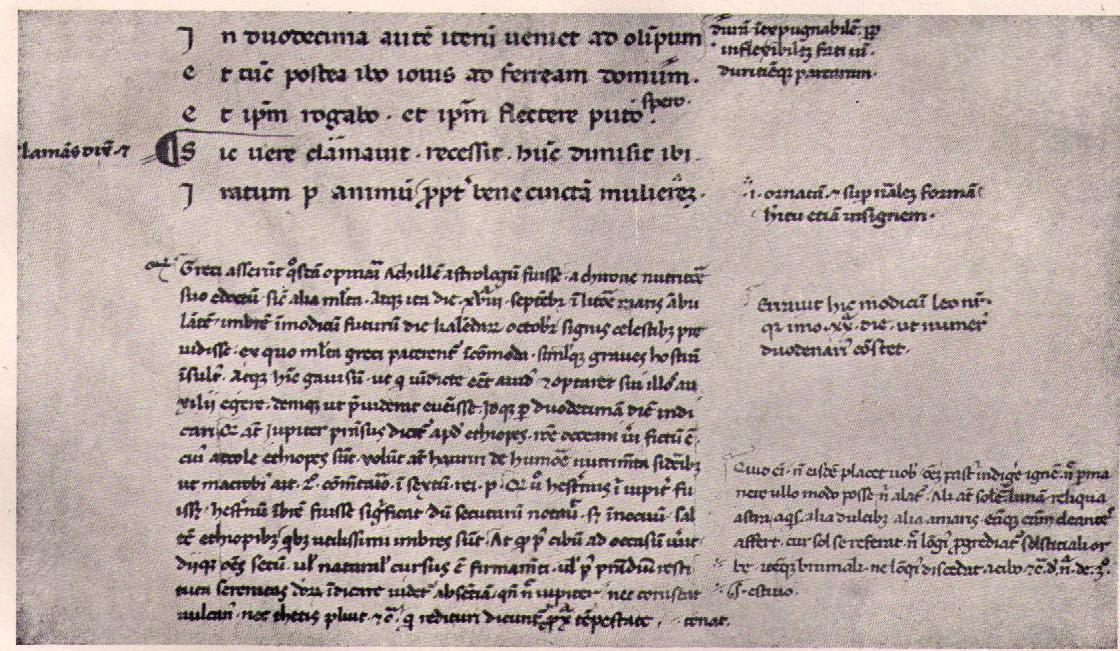
Petrarch's reading notes in his manuscript copy of a Latin translation of Homer's Iliad (reproduced from James Harvey Robinson, Petrarch: The First Modern Scholar and Man of Letters [N.Y.: G.P. Putnam's, 1907]):
Alphabet practice in a Renaissance hand recorded on three leaves of the "Winchester Manuscript of Sir Thomas Malory's Morte Darthur (from The Winchester Malory : a facsimile [London ; New York : Oxford University Press for the Early English Text Society, 1976])
Alphabet practice and dated late Renaissance readers' signatures in the Bright Collection copy of George Wither's Abuses Stript and Whipt: or Satyricall Essayes. London: Humfrey Lownes for Francis Burton, 1617. James Wilson Bright Collection, Goucher College. PR2392 .A28 1617 (John Thorpe attended College of St. John Evangelist, Camb. in 1664, and sizars attend a "Mr. Sandford" in the 1670s).
1) 1994: Joseph A. Dane's epitaph discovery at the foot of the title page's printers ornament in a Kele 1550 edition at The Henry Huntington Library
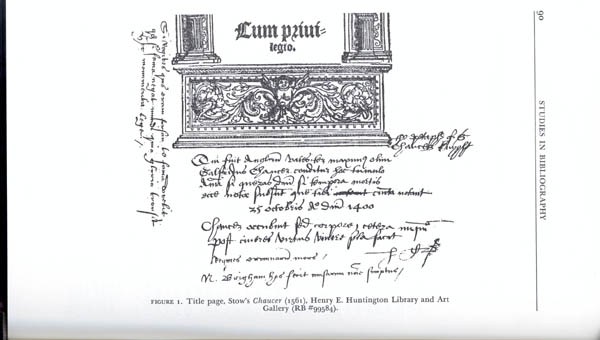
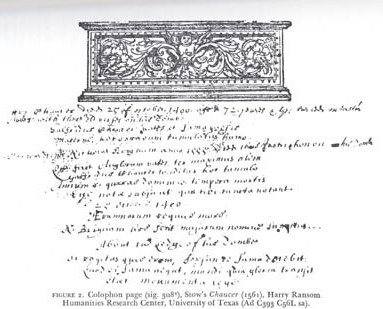
2) 1994: Alexandra Gillespie's epitaph discovery on the colophon page of a 1561 Stow edition at the Harry T. Ransome Center Library (U. of Texas at Austin)
3) The first epitaph inscription I discovered on the colophon page of a Stowe 1561 Edition (JHU Catalog PO1850 1561a) [the "second" Garrett Library copy, from the Collection of the Tudor and Stuart Club]
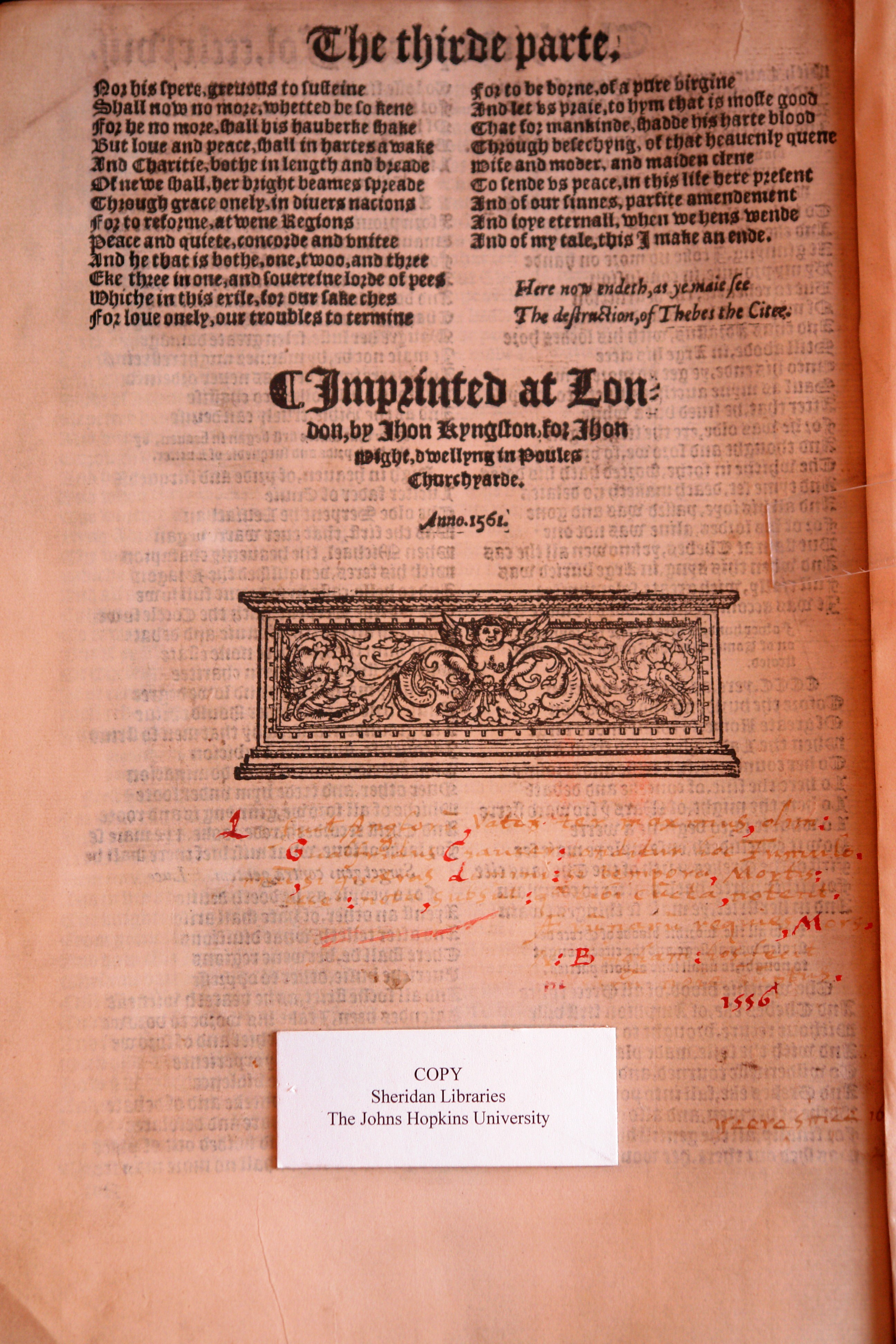
| Transcription of the Garrett library "second" 1561 copy (rubrication imitates medieval manuscript style) | Joseph Dane & Alexandra Gillespie Transcription (Huntington and Ransome Center copies) |
|
Qui fuit Anglor<um> vates ter maximus, olim: Galfridus Chaucer, conditur hoc Tumulo Ann<um>, si queras domini: si tempora, Mortis: ecce: nota, subsunt: [que?] tibi cuncta, notant. Æ<um>mar<um> requies, Mors. N: B[ri?]gam: hos fecit [?musarum sumptus] 1556 |
Qui fuit Anglorum vates. Ter maximus olim Galfridus Chaucer. conditur hoc tumulo Annum si queras domini si tempora mortis ecce nota subsunt. que tibi cuncta notant. [ . . . ] <He who was once the thrice greatest English poet, Geoffrey Chaucer, is buried in this grave if you ask the year of the Lord, the period of his death, look at what is written below, which tells you all.> recquies erumnarum mors <The relief of all troubles is death. Nicholas Brigham assumed these
expenses in the name of the Muses. 1556 (tr. Dane)> |
4) The second epitaph MS I discovered at the end of Chaucer's works in a Stowe 1561 Edition (JHU Catalog PO1850 1561) [the "first" Garrett Library copy]
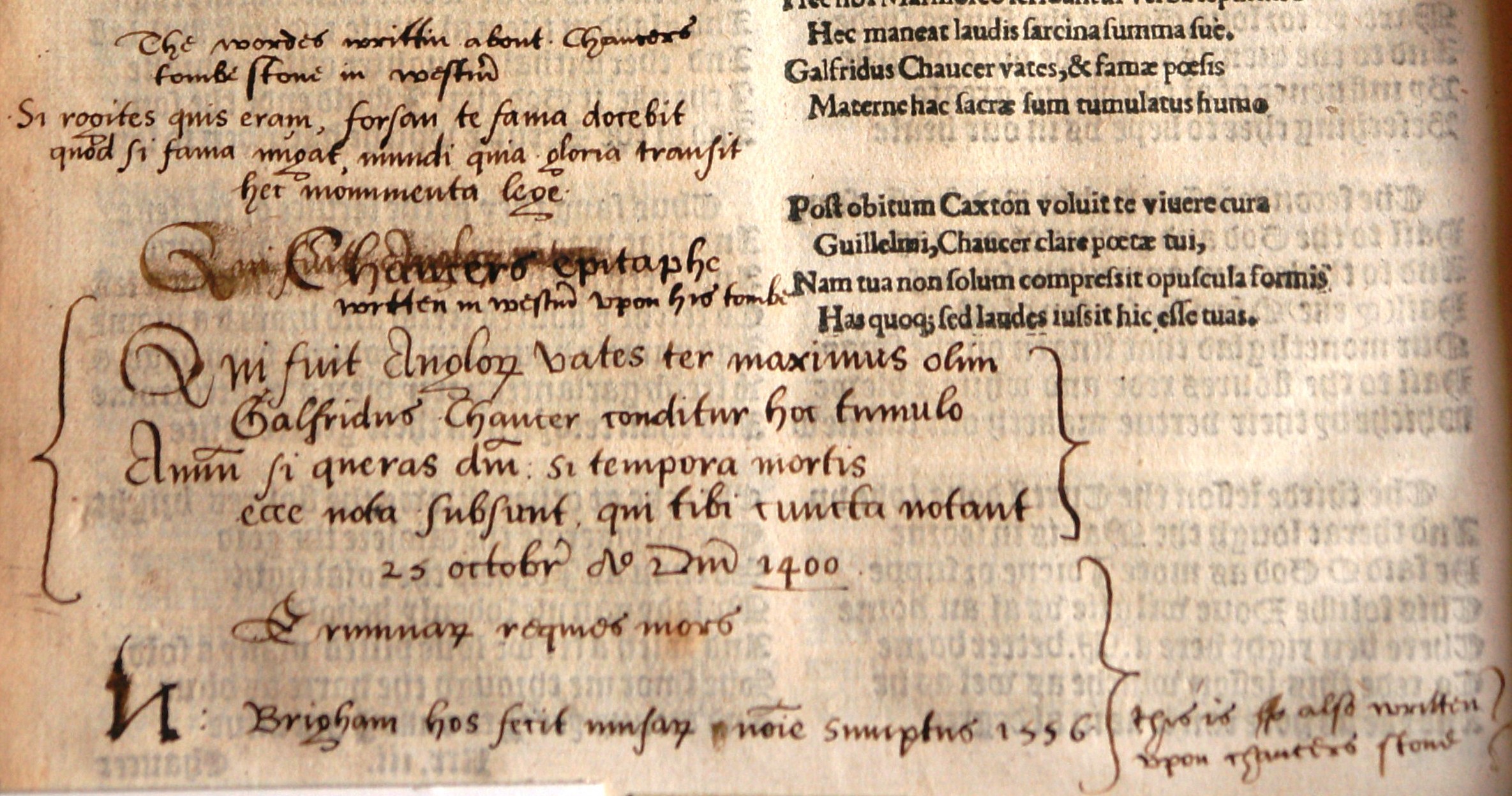
| Transcription of the Garrett Library "first" 1561 copy | Joseph Dane & Alexandra Gillespie Transcription (Huntington Library and Ransome Center copies) |
|
The wordes writtin a bout Chaucers tombe ſtone in Weſt<minster> Si rogites quis eram, forſan te fama docebit quod ſi fama negat, mundi quia gloria tranſit hec monumenta lege
written in West<minster> upon his tombe Qui fuit Anglon vates ter maximus olim Galfridis Chaucer conditur hoc tumulo An<n>um ſi queras d<omi>ni si tempora mortis ecce nota ſubſunt, qui tibi cuncta notant 25 octob<e>r a<n>o D<omi>ni 1400
Ærrumar<um> requies mors N: Brigham hos fecit musſar<um> <nomine> sumptus 1556 } wordis also writtin upon chaucers stone |
[The “verses about the ledge”] Si rogites quis eram forsan te fama docebit quod si fama negat mundi quia gloria transit Hec monumentie lege. Qui fuit Anglorum vates. Ter maximus olim |
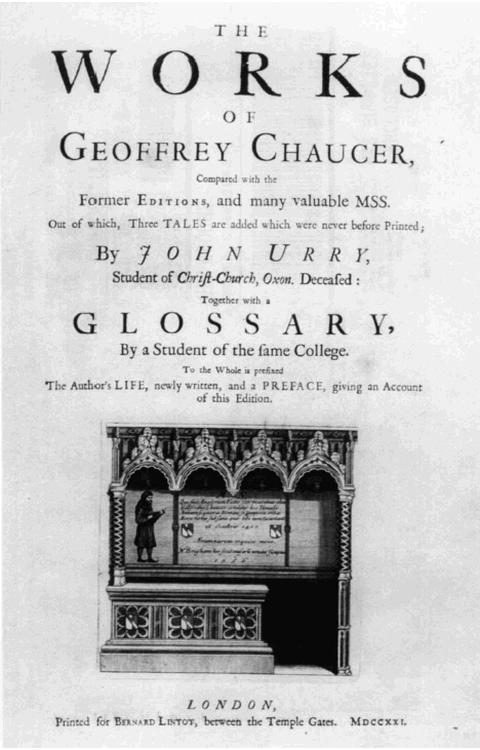
Title page of the John Urry edition of The Works of Geoffrey Chaucer, London: Bernard Lintot, 1721. (Special Collections Oversize PR1850 1721)
Coda: Edmund Spenser (1596) on Chaucer's fame
Next steps--surveying available C17 copies.