ENGLISH 211: English Literature Beowulf to Dryden
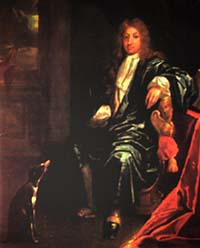
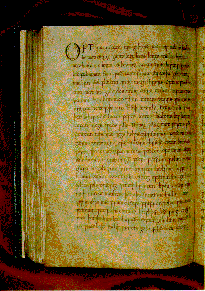
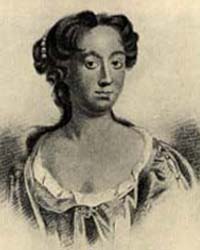
John Dryden (1631-1700) "The Wanderer" MS (c. 965) Aphra Behn (1640?-89)
Section .01 / Fall 2012
Instructor: Arnie Sanders [Click
here for all course web pages,
CV, recent research, etc.] VM 141
Department of English,
Goucher College
Office Hours: M-W-F
11:00-12:00 and by appointment Page last
updated:
08/15/2015 04:51:15 PM
Recent site news--12/11/14: As you prepare for the final exam, remember that you do not have to and probably should not attempt to be equally familiar with all the works we have read in this semester-long survey of early English literature. The course's intention was to expose you to enough literature so that you could choose which authors to pay attention to as part of your personal "canon" of English literature. Make your choices mindfully, and determine what links them together or divides them. Look for individual styles of authorship that distinguish one writer from another, but also look for the large patterns of cultural change and continuity, such as identity (stable/inflexible or created by one's self or one's surroundings?), gender and courtship and love and marriage, religious and philosophical values (pagan, pre-Reformation medieval Christian, Protestant vs. Catholic, and agnostic/atheistic), literacy and evidence of readers' effects on authors, and authors relationship to previous authors from whom they learned their craft.
Final Paper Requirements (the short version--see Required Graded Work below for the whole megilla): The Second Paper must be concerned with at least two works of literature we will have read by the end of the course, and the primary focus may not be on a text read before the midterm exam. You also can write on two parts of one major work from the second half of the course (e.g., Volpone, Paradise Lost, Oroonoko, The Way of the World). There is no page length minimum, and no page length maximum. As long as the papers sincerely engage at least two texts (or parts of a major text, see above), I will evaluate them on the quality of their argument, not on the quantity of their verbiage. Because this paper serves as an instrument to measure Writing Proficiency in the Major for some English Majors, in addition to your primary sources, I require you to refer to at least some scholarly secondary sources.
Link to the required "Academic Honor Code" statement--read it once; remember it forever.
Here is the Link to the In-Class Performance Schedule and my Evaluation criteria for performances, tips, and my reasons for doing this. Just email me your preferences and I will put your name into the slot as soon as I get your message.
What do historical surveys of literature help us to see that seminars on single works or authors cannot see? For one thing, seminars, era-based and limited thematically organized courses have already established their boundaries and internal divisions, but in a survey course, except for its beginning and end, students and the instructor have to establish "milestones" within the flow of readings to create meaningful connections among authors and works and the cultures which produced and consumed them. We both must work at that, but it's a chance for genuinely creative thinking as you decide, for yourself, what the "canon" of English literature will be in the 21st century. Controversies emerge in the literature and are resolved as authors take up their own literary inheritance or try to introduce something new to the way literature is created, and in those controversies, we can see many cultural threads coming together at once in multiple works and many author's careers.
Frequently useful Web pages for 211: Levels of claim in a thesis--a Web page for my English 104 students, but useful to think about re: theses about literary interpretation. Poetic "Feet" Terms Poetic Meter Terms Rhyme Scheme in Stanzas Stanza Structure Greek Origins of Poetic Genres The English Short Title Catalogue (ESTC)--the tool for figuring out the popularity of authors and titles published between 1473 and 1800: http://estc.bl.uk/F/?func=file&file_name=login-bl-estc&local_base=bll06 Concordances--an English major's "super dictionary" to authors' use of words.
Course Description
English 211 introduces you to British authors, works, genres, ideas, and movements which will help you understand the development of the English language and its literature from its earliest inceptions to the emergence of Modern English in mass market print production. During this period, English culture was transformed from a small group of feudal kingdoms, each based on landed wealth controlled by a hierarchical aristocracy and the church, to a single nation-state ruled by a parliamentary government and based on an international capitalist trading empire that reached from the Appalachian Mountains of North America to India in the East. For English majors, the course's emphasis on the "big picture" will provide essential context for interpretations of works studied at greater length in upper-division courses. For non-majors and majors alike, the course offers the chance to explore your language's heritage in the works of its most influential and talented writers. Our goal is to surrender to these texts long enough to experience their effects upon an audience of competent readers, and to separate ourselves from them with enough insight to detect the strategies by which they subjected us to "the dream of the text."
Before the first class meeting, please read the "Syllabus View" and "Bottom Line" pages to see how the course is constructed and what graded work will be considered for the final course grade. Read the "Text Book Purchases" page for important advice if you are going to buy the books early and read ahead. If you are worried about how to remember and understand what you read for the course, click here for my single best piece of advice about how to study. To understand how the syllabus was constructed and English 211's main goals for its students, read this historical overview of the course's readings and this rationale for why you should care about this course. These three short descriptions of Old English (the language of the Anglo-Saxon tribes in England), Middle English, and Early Modern English also will help you understand the course's historical/linguistic "flow." Around Thanksgiving of each semester, we finally break through into Modern English when reading literature produced during and after the English Civil War (1642-59). You would do well to read a bit about what distinguishes "modern" mentalities from "pre-modern" ones. It's a huge cultural and psychological leap.
The Norton Anthology has included women writers only in the comparatively recent
history, and women writers still are under-represented in typical print surveys
of early literature. Click here for the
Brown University Women Writers Project:
(Goucher College users only--subscription account.) You can
find additional works by early women writers at the Emory Women Writers Resource
Project at Emory University's Lewis H. Beck Center.
|
|
since August 31, 2007 reset.
Last year, between August 29, 2006 and August 31, 2007, we had 5086 hits.
Between September 2, 2005 and August 29, 2006, this page had 4414 hits.
Between August 30, 2004 and September 2, 2005, this page had 4984 hits.
The year before it had 3506 hits, and the year before that it had 3198 hits.