ENGLISH 240: Medieval Literature
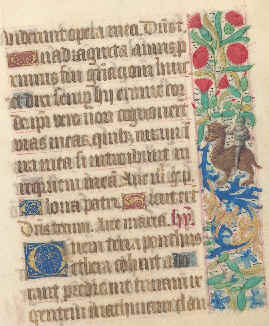
A leaf from a Book of Hours, probably from Poitiers circa 1470, recording the Little Office of the Virgin, a portion of the Mass
Spring 2014
Instructor: Arnie Sanders
Spring Semester Office Hours (141): TuTh 11:30-12:30 and by appt.
Department of English,
Goucher College
Page last updated:
0 02:01:06 PM2/11/2020
New! 2/11/20--St. Francis Missal (W.75) and Book History: class pages for McDaniel College, Professor Wronski, English 2230
3/29/16--"Sir Thomas Malory" class pages for McDaniel College, Professor Wronski, English 2230
The site is resting after the Spring 2014 course. If you have questions about medieval literature or old books and manuscripts, please contact me through my Goucher email account (asanders etc.).
Want to see a medieval manuscript that was peed on by a cat?
Pearl Paper Images in PowerPoint
As soon as possible, check this schedule and email me to pick two classes/texts on which to do in-class presentations, one from before Spring Break and one from after Spring Break. There are seventeen openings before SB, and thirteen afterward, for twelve people presenting. If you find yourself with a bad schedule, negotiate with presenters on days that would work better for you. If you cannot manage a swap, especially in the tighter post-SB period, I can add another presentation to a day that has only one. When there is more than one presentation slot for a day, be sure to specify which text you want to present on. If, as is likely, you are unfamiliar with the readings, click on the Web page linked to the text for a quick description of what's going on. Click here for guidance for how to prepare the presentations. Note that you should not try to "cover" the reading for the day. Focus your presentation on some issue or passage of interest to you, and use the Voice Board to record performances of the passage or passages to illustrate what you find interesting. Middle English Practice Conference sign-up page. Click here a general comparison of modern and medieval wealth-based notions of "diverse perspectives." The term "worldview" used in the SLOs below can be understood as the habits of seeing and understanding we can detect in narrators and characters governed by their religious, socio-economic, and other characteristics in the era from which the work originates. It is approximately synonymous with "mentalité," a term more commonly used by medievalists.
Chaucer Sound Files at Alan Baragona's "The Crying and the Soun" page (VMI).
Analytical Themes in English 240: This list of issues that are likely to emerge as we read and discuss this material is intended to stimulate your thinking and to help you find points of connection for your in-class presentations. The list is offered to help stimulate your thinking, but it is not intended to limit other kinds of inquiries you might pursue. Applying Critical Methods from English 215 to English 240: Reading early literature challenges beginners because the strangeness of the language is compounded by the strangeness of the customs, social roles, and almost every expectation one might bring to the earlier era from our own. Take delight in that strangeness! Let it show you an aesthetic and cultural norm that will challenge you to think like someone from another time.
Rota Fortuna from the Codex Burana (ca. 1230) Medieval chess in a Walters Art Museum ivory medallion Iron Gall Ink Corrosion Forms of the medieval text and levels of student commitment. Modern and Middle English Open Vowels Material culture study opportunity: stained glass windows
Summary
English 240 is an intermediate level introduction to medieval culture and Middle English literature. What were medieval readers reading when they could not find their manuscripts of “Canterbury Tales”? This introduction to medieval English literature looks at a variety of non-CT narratives to discover how our ancestors understood love and death in the pre-modern era. Chaucer’s dream visions and his great romance, the Troilus, will be included, of course, but we also will explore literature written by Marie de France (in translation), author of one of the oldest werewolf stories in the Anglo-French tradition (“Bisclavret”). The Pearl-Poet, anonymous author of Pearl and Sir Gawain and the Green Knight, will tell us what heaven looks like, how to talk when your head has been cut off, and how to respond when your host’s wife surprises you in bed and offers you her body. Sir Thomas Malory, the translator/forger/author of the Morte Darthur, will tell you what really happened with Arthur, Lancelot, and Guenivere, and whether Arthur will ever return. The anonymous creators of the Middle English Breton lais will show you how the modern “short story” was born, how to identify abandoned children of nobles and of demons, and how to win your wife back from the King of Faerie. To help us put all this in the context of real medieval life, we will read some of the first “last wills and testaments” written in English, and excerpts from a work that will enable you to answer one of rock-and-roll’s oldest questions: “Who wrote the book of love?” (Answer: Andreas Capellanus, 1184-86, De amore honesti [“The Art of Courtly Love”])
Student Learning Outcomes: (click on the link for an explanation of what these things mean)
1) Students will demonstrate Middle English reading skills to experience directly the way C12-15 people experienced their world in literature and in documents they used to negotiate their lives' most important moments (e.g., didactic or romance narratives, "last wills" of the dying, ceremonies of fealty and homage for feudal relationships, marriage ceremonies, etc.).
2) Students will learn to interpret Middle English literature with full respect for its elements of continuity with Modern culture, and for its stark differences of mentalité, social organization, and aesthetics, using the terms of art by which modern medieval studies scholars analyze and understand these texts. Click here for descriptions of some major themes which could guide your interpretation of Middle English literature.
3) Students will use textual evidence to reconstruct and to distinguish the world-views of medieval men and women of many "estates" and occupations, avoiding reductive generalizations about "the medieval audience" and seeking evidence of the full diversity of this era's linguistic and emerging national identities. They will be able to explain the socio-political and economic contexts which shape those world-views, and can analyze the differences between two or more of them found within one or more works (e.g., codes of "chivalry" in Chaucer's Boke of the Duchess vs. in Sir Gawain and the Green Knight).
4) Students will be able to analyze individual works of Middle English literature in their generic contexts (e.g., romances, lyrics, dream visions), their thematic contexts (e.g., Arthurian literature, advice and complaint literature), and their material contexts as they have survived in manuscripts and early modern printed editions.
"Academic Honor Code: Reference to the academic honor code is required of all course syllabi as a reminder to students. Suggested wording includes: Reminder: All students are bound by the standards of the Academic Honor Code, found at www.goucher.edu/documents/General/AcademicHonorCode.pdf."
So much for what the college requires me to tell students about the Honor Code. This policy is unfortunate, because frequent, forced repetition of important statements of values results in the diminishment of those values in the minds of the benumbed witnesses (i.e., the students). I believe in honor as a human achievement that one can win or lose by one's actions, especially as it applies to scholarly study. I also see some value in codifying what "honor" means. Here is my attempt to do so. I distinguish between accidental plagiarism, in which the author obviously intended to cite sources but carelessly cited them at the wrong place, and outright theft of intellectual property intentionally passed off as one's own. Cases of the first type usually are opportunities to teach and learn, but they may go to the Honor Board if they happen late in the semester, after we have discussed source use and its importance to your readers. The second type will be sent to the Honor Board without hesitation. Students also are increasingly content to cite sources long after their prose has begun to borrow ideas from those sources. That is technically plagiarism, too, but it has become so common that I must spend gallons of ink and hundreds of keystrokes un-teaching it. Never make me guess whose ideas I'm reading. Cite sources when you first depend on them. I am more interested in knowing how well you can think than in how well your sources can think. Let there be a bright line of fire between ideas that are originally yours and those of other writers to which you refer.
hits since 1/29/08 reset.