ENGLISH 330: Geoffrey Chaucer, The Canterbury Tales
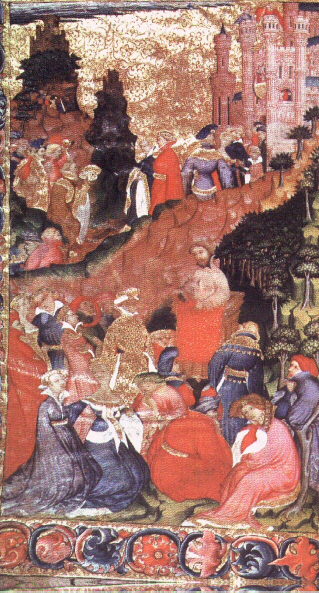
Geoffrey Chaucer (?1340-1400) performing for a courtly audience (Cambridge Corpus Christi MS 61)
Spring 2015: Wednesdays,
12:30-3:00 Office Hours TuTh 11:30-12:30, and by app't. (just call or email)
Instructor: Arnie Sanders
Department of English,
Goucher College (Page last updated
04/27/2015 06:30:05 PM)
Recent site news: 4/27/15--Tale Presentation Schedule, Spring 2015 For a guide to what I am looking for in tale presentations, click here. Emma Day's Pardoner Presentation.
"Canon's Yeoman's Tale" and "Manciple's Tale" are the next-to-last tales in the CT cycle in the "a-group" manuscripts, but not in all manuscripts. In the a-group MSS, they always come before the "Parson's Tale" and "Retractions," and after the Second Nun has told us of St. Cecelia. But in the numerous b-group MSS, CYT follows "Franklin's Tale" (Arveregus, Dorigen and Aurelius) and comes before "Physician" (Virginius, Virginia, and the evil Roman judge). This is also the order of the c-group and d-group MSS, so by sheer numbers of surviving MS "witnesses" to Chaucer's intentions, that is the order in which we should be reading them. "Manciple's Tale" always preceeds "Parson's Tale" in all tale orders. That looks, to me, as if CYT and ParsT-Ret belong together as a unified group as solid as the first fragment (GP-KT-MT-RT-Cfrag). Interestingly, in MS Hengwyrt, that unique survivor from the marches of Wales, the Second Nun pipes up between the Franklin and the Clerk (Griselda and Walter), the Manciple comes just before the Parson, and there is no Canon's Yeoman to tell a tale. Does this tell us something about Chaucer's evolving feel for the whole cycle of tales of Canterbury?
Chaucer Sound Files from Alan Baragona's site are linked here.
Annotated Bibliographies: My bibliographic annotations tend to be more complete than those I've seen written for other Goucher seminars. For advice about selecting articles and preparing annotated bibliography entries, click here. To read bibliographic notes from the previous seminars' students, click here. If you read a few of them, you will realize that some tell you more, and more useful things about the article's thesis, evidence, and usefulness. Follow the good ones as models. It is permissible to re-annotate an article someone else already has done, but your annotation must remain your own. Consider re-doing annotations that seem deficient in one or more areas to improve upon them.
Announcement: the new Book Studies minor (BKS) has been approved. If you are interested in old books and manuscripts, the history of literacy and book production, and hands-on work with rare objects, please consider signing up for English 241, Archeology of Text. Click on the link to see the course home page--a link to the fall 2013 syllabus is on the bottom menu. The course will be offered again in the fall semester of 2015. It will teach you the other side of literary research, the physical examination of literary works in the forms in which they were read by their authors and first readers. 241 offers hands-on experience in both archival and rare-book research, and places the modern emergence of digital literacy into perspective by comparing it with the previous transition from manuscript to hand-press printed books, and from the scroll to the codex (what you think of as a "book"). Students who have taken 241 have won internships at the Library of Congress and the Folger Shakespeare Library, and five members of the Fall 2007 class were accepted to study in graduate programs in English literature and library science. Click on the link to see the course's web site. I also need a paid teaching assistant whom I will train to locate, prepare, and handle books and manuscripts from the collection for use in class meetings. If interested, please contact me.
Concordance to the Works of Geoffrey Chaucer: Constructed by Gerard neCastro of University of Maine, Machias, this should be an essential tool to augment the O.E.D. definition of words in common usage. The concordance gives us a much more precise sense of Chaucer's usage, and can establish thematic relationships among similar usages even when they are far apart in a text.
Click here for my own "hard word" glossary for Middle English words which typically pose problems for Modern English speakers. To help you continue to teach yourself to read Middle English aloud, check out this web page on Modern and Middle English open vowel sounds. It gives you the pronouns (I, you, he/she/we, they) as examples of how to sound the open vowels which went through the Great Vowel Shift (ca. 1400-1500): It also includes two priceless diagrams illustrating where you would sound the Modern English and Middle English open vowels. Click here for a discussion of the "three estates," the way medieval Anglo-European culture understood its social organization (by birth and occupation vs. "the three classes," by wealth).
Please visit the Writing Center for assistance in developing and polishing all written assignments for English 330. At first, working in Middle English will pose additional, unfamiliar interpretive challenges that may push you out of your comfort zone for writing literary analysis. Later, as we see more of the great construction that the "Tales" create, you will have more to say than you are used to, and it will take time and conversation to figure out what would be best to say now.
Some links to current and past medieval-related projects: Hobbit Project, Medieval Institute Talk, Kalamazoo, "Writing Fame" (Chaucer Epitaphs in Renaissance Chaucer editions) MI, May 13, 2010; Medieval Institute Talk, Kalamazoo, "Pearl's Hyperbole/ae" (reading "Pearl" in manuscript facsimile, scribal evidence for intentional errors in form), May 9-13, 2013 (draft). For the full congress program, click here.
Frequently useful images: Medieval Music in MSS; Glossa ordinaria (Justinian's legal code); Midrash Shoher Tov on Psalms; Annunciation MS illumination (Met. NYC) London Gazette
Seminar Description
The seminar will read Geoffrey Chaucer's Canterbury Tales in Middle English, as well as some of the tales' known sources and analogues. We also will examine the growth of Chaucer's Renaissance reputation by consulting early print editions of his works located in Goucher's Rare Book Collection and those of other area libraries. Our primary purpose is to understand how the Canterbury tales work, individually and as parts of a grander conception bound together in various possible orders by the pilgrimage "frame narrative." Periodically during the semester we will compare the tales we are reading in the current scholarly edition (the Riverside Chaucer) with the versions in Renaissance editions to discover how Shakespeare and other early readers constructed their "Chaucer" as "the father of English literature." We will have more fun doing what we're doing than any other seminar at Goucher College because we will get to handle (with well-washed hands) rare books and manuscripts of the sort that other literature courses hide from their students, relying upon false certainties inspired by modern print editions. We also will be reconstructing another cultural context in which we can read "the naughty bits" without the FCC's prohibition on profanity.
"Academic Honor Code: Reference to the academic honor code is required of all course syllabi as a reminder to students. Suggested wording includes: Reminder: All students are bound by the standards of the Academic Honor Code, found at www.goucher.edu/documents/General/AcademicHonorCode.pdf." I distinguish between accidental forms of plagiarism, in which the author obviously intended to cite sources but cited them at the wrong place, from pure carelessness (no citations, even if sources are listed at the back) and outright theft of intellectual property intentionally passed off as one's own. The first type of cases usually are opportunities to teach and learn. The second type are more troubling and may go to the Honor Board if they happen late in the semester, after we have discussed source use and its importance to your readers. The last will be sent to the Honor Board without hesitation. Students also are increasingly content to cite sources long after their prose has begun to borrow ideas from those sources. That is technically plagiarism, too, but it has become so common that I must spend gallons of ink and hundreds of keystrokes un-teaching it. Never make me guess whose ideas I'm reading. Cite sources when you first depend on them. I want to know how well you can think, not how well your sources can think, which is a matter of historical record for anyone who reads them. Let there be a bright line of fire between ideas that are originally yours and those of other writers to which you refer.
since 2/5/07 reset.
